 Menu
Menu

In the world of modern wire processing, the importance of a reliable and efficient wire uncoiler cannot be overstated. Whether you’re operating in high-volume production or managing precision tasks on a small scale, the way you handle wire delivery can dramatically influence productivity, machine longevity, and product quality.
When it comes to choosing between a pedestal wire uncoiler and a cabinet-mounted wire system, understanding the differences is key. In this article, we break down the pros and cons of each and help you determine which type of wire uncoiler for production best fits your operational needs.
What Is a Wire Uncoiler and Why Is It Crucial for Production?
A wire uncoiler is a mechanical device designed to feed wire from a coil or spool into downstream processing machines. These machines include straighteners, cutters, and forming units. A smooth, uninterrupted feed is critical for reducing tension inconsistencies, minimizing wire damage, and maintaining efficient production flow.
Whether you’re working with copper, stainless steel, or coated wires, the right wire uncoiler for wire processing ensures your system runs efficiently and safely, making it a cornerstone of your wire feeding system.
Pedestal Wire Uncoilers: A Flexible and Space-Saving Solution
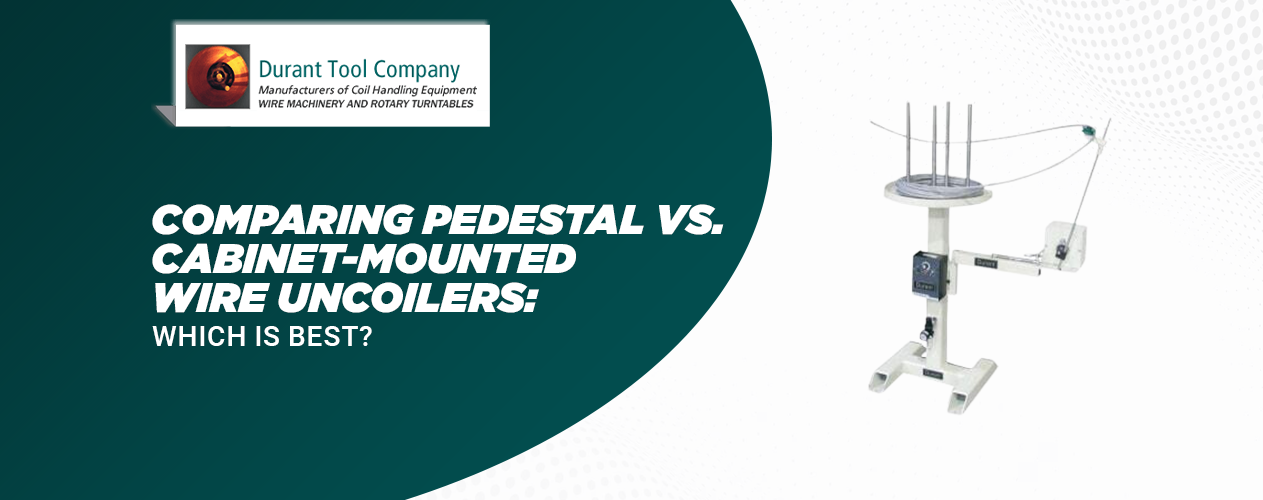
Pedestal wire uncoilers are typically open-frame, freestanding units that provide excellent flexibility. Their straightforward design makes them a popular choice for job shops and production floors where mobility and accessibility are key.
Benefits of Pedestal Wire Uncoilers:
- Mobility: Easily repositioned across workstations or machines.
- Simple access: Fast spool changes and visible operation.
- Compact design: Ideal for limited-space environments.
- Cost-effective: Fewer components and easier maintenance.
These uncoilers are often used in setups that prioritize manual control or require frequent spool changes. For example, the Durant Pedestal Wire Uncoiler Machine offers a high-quality, industrial-grade option with robust capacity and ergonomic handling, perfect for dynamic workspaces.
Cabinet-Mounted Wire Uncoilers: Maximum Control and Protection
In contrast, a cabinet-mounted wire uncoiler is enclosed in a metal housing that offers additional protection and often includes tension control systems. These are commonly found in high-speed or automated operations that require consistent wire feed performance.
Why Choose a Cabinet-Mounted Wire Uncoiler?
- Dust and debris protection: Great for cleanroom or sensitive environments.
- Improved safety: Less operator interaction with moving parts.
- Tension management: Internal brakes and guides control wire feed.
- Integrated systems: Often paired with automated feeders or cutters.
Because they are fully enclosed, cabinet-mounted wire uncoilers help prevent material contamination and damage, especially important in electronics, aerospace, or medical component manufacturing.
Feature Comparison: Pedestal vs. Cabinet-Mounted
Choosing between pedestal and cabinet-mounted models depends on your production environment, operator preferences, and integration needs. Here’s a quick breakdown:
| Feature | Pedestal Wire Uncoiler | Cabinet-Mounted Wire Uncoiler |
| Mobility | High | Limited |
| Wire Visibility | Fully exposed | Enclosed |
| Tension Control | Manual | Built-in |
| Protection Against the Environment | Minimal | Excellent |
| Maintenance | Easy | Requires disassembly |
| Cost | More budget-friendly | Higher upfront investment |
| Integration in Automation | Limited | Ideal |
If your wire processing needs involve automation and high-speed applications, a cabinet-mounted wire uncoiler with precision tension control may be the better choice. But for flexibility and easy maneuverability, pedestal units offer significant advantages.
Don’t Overlook System Integration: Wire Decoilers and More
When planning your wire handling setup, it’s important to consider the full wire feeding system, not just the uncoiler. Devices such as wire decoilers, tensioners, straighteners, and cutters must all work in harmony.
Another essential component is a wire spool holder, which ensures stability and consistent feeding regardless of spool size. Combining these parts into a well-integrated system helps prevent kinks, tangles, and feed delays.
Also, consider whether your operation might benefit from an adjustable wire uncoiler for wire processing with braking features or foot-activated feed controls. These details make a major difference in day-to-day productivity and safety.
Which Is Best for You?
Ultimately, choosing between a cabinet-mounted wire uncoiler and a pedestal wire setup depends on your specific business needs:
Choose Pedestal If:
- You need mobility across workstations
- Your operations involve varied or short-run jobs
- You prefer lower-maintenance equipment
Choose Cabinet-Mounted If:
- You operate in a high-speed or automated production environment
- Contamination prevention is a priority
- You require advanced feed regulation
Whatever your choice, investing in the right wire uncoiler can boost operational efficiency and support a scalable, reliable wire feeding process.
Built to Support Industrial Growth
At Durant Tool Company, we understand that every production line has unique requirements. That’s why we provide industrial-grade uncoilers, both pedestal and cabinet-mounted, built for durability, ease of use, and integration into advanced wire systems.
Our equipment supports everything from basic wire spool holder needs to fully automated wire feeding system solutions, designed to meet the high standards of wire forming, stamping, and coiling operations. Whether you’re upgrading your existing setup or designing a new one, Durant Tool Company is ready to help streamline your wire processing with efficiency and precision.


