 Menu


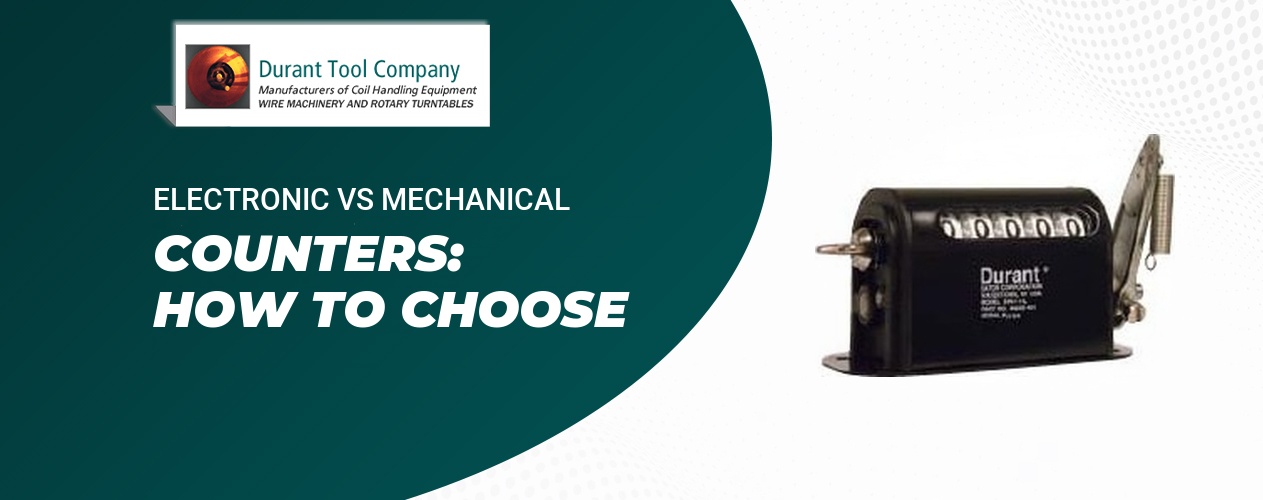
Electronic vs Mechanical Counters: How to Choose the Right Production Counter for Your Machine
A production counter does one job: it tells you how many. How many strokes the press made. How many parts dropped in the bin. How many feet of wire went out the door. Simple, right?
Mostly. The trouble starts when the wrong counter lands on the wrong machine. A light-duty counter on a pounding punch press skips counts. A battery-powered display in a greasy, hot cell fades early. And a counter anyone can reset with a thumb ends up reading "000000" five minutes before the shift report is due.
Picking the right one is easier than it looks. It mostly comes down to three questions: how fast, how tough, and how smart does the count need to be?
Key Takeaways
To choose a production counter, match the counter type to your signal and your shop. Mechanical counters suit simple, lever-driven counting with no power. Electromechanical counters handle powered, high-speed pulse counting with a rugged readout. Electronic counters add presets, batching, rates, and outputs that can stop or signal a machine.
| What to Check | Why It Matters | Simple Rule of Thumb |
|---|---|---|
| Count source | The counter must read your motion or signal | Lever or shaft = mechanical; electrical pulse = electric or electronic |
| Count speed | Too slow a counter misses counts | Check the counts-per-minute rating against your fastest cycle |
| Power available | Some counters need AC or DC; some need none | No power at the machine? Go mechanical or battery LCD |
| Environment | Oil, dust, and shock shorten counter life | Pick enclosed, rustproof, dustproof builds for the shop floor |
| Reset control | Accidental resets wipe out records | Use tamper-proof or keylock reset where counts matter |
| Control needs | Some jobs need the counter to act, not just count | Need batching or a stop at a preset? Go electronic |
USA-Made Stroke Counters, Built for the Floor
Durant Tool Company builds light, medium, and heavy duty mechanical stroke counters for presses and production machines, backed by a three-year warranty.
Explore Stroke CountersWhat Is a Production Counter, and Why Does It Matter?
A production counter is a device that tracks how many times something happens on a machine. Each stroke, turn, or pulse adds one to the total. The display shows that total so operators and supervisors can see output at a glance.
Counters show up all over a plant:
- Counting press strokes on stamping and punching machines
- Counting finished parts on packaging and assembly lines
- Tracking turns on coil winding and spooling jobs
- Running batch counts so a line stops at the right number
A good count is more than a number on a dial. It drives tool maintenance schedules, job costing, and shipment counts. If the count is wrong, everything built on it is wrong too.
The Three Main Types of Production Counters
Most industrial counters fall into three families. Each one reads a different kind of input and suits a different job.
| Feature | Mechanical Counter | Electromechanical Counter | Electronic Counter |
|---|---|---|---|
| How it counts | Lever, stroke, or shaft turns gears | Electrical pulse drives a magnetic coil and wheels | Electronic circuit reads input pulses |
| Power needed | None | AC or DC supply | AC, DC, or battery |
| Display | Number wheels | Number wheels | LCD or LED digits |
| Extra features | Basic reset | Basic or electric reset | Presets, batching, rate, outputs |
| Best for | Simple stroke counting | Powered, high-speed counting | Control, batching, and monitoring |
Mechanical Counters: Simple and Self-Powered
A mechanical counter is driven by physical motion. A lever or shaft on the counter moves each time the machine cycles, and gears advance the number wheels. No wiring, no batteries, no power supply.
That makes a mechanical counter a natural fit for presses and machines where you just want a dependable stroke count. Durant's mechanical stroke counters come in light, medium, and heavy duty versions. The light and medium duty models are built rustproof and dustproof, and the well-known "D" model medium duty counters come in 4, 5, or 6 figures.
For tougher jobs, Durant's heavy duty stroke counters use stainless steel shafts in oil-less bearings. The drive is designed with overstroke, so the counter does not bottom out when the machine overtravels. That is a small detail that saves a lot of broken counters on hard-hitting presses.
When you need to count rotation instead of strokes, mechanical revolution counters do the same job on a turning shaft. For a look at how these classic designs keep improving, see our post on the latest innovations in mechanical counter design.
Electromechanical Counters: Powered Counting with a Rugged Readout
An electromechanical counter is also called an electric counter. Instead of a lever, an electrical pulse energizes a small magnetic coil, which advances the number wheels. A switch, sensor, or relay on the machine sends the pulse.
This type shines when the motion you want to count is hard to reach with a lever, or when the machine runs too fast for a mechanical drive. Durant's RMF Series electric counters are rated for accurate counts at speeds up to 1,000 counts per minute. They are fully enclosed to keep out moisture and dust, need no lubrication under normal conditions, and come in 6 or 7 figures.
For tight panels, the ME Series miniature electric counters run on as little as 3 watts and weigh about three ounces. They come in 4, 6, or 7 figures with a tamper-proof sealed figure window.
Electronic Counters: Counting That Also Controls
An electronic counter reads input pulses with a circuit and shows the total on a digital display. The big difference is what it can do with that number.
Many electronic counters can:
- Stop or signal a machine when a preset count is reached
- Run batch counts and keep a running grand total
- Show rate, such as parts per minute or motor speed
- Count up or down from a set number
Durant's Presidential Series monitors and controls cover simple production counting, batching, packaging, roll forming, motor speed monitoring, parts counting, and coil winding. Options include single and dual presets with rate, batch, and totalizer functions.
If you only need a long-running total, a compact LCD totalizer is a simple choice. Durant's eight-digit LCD totalizers accept a wide input range of 10 to 260 Vac/Vdc pulses, include a filter for bounce-free counting with mechanical contacts, and the battery-powered version has an approximate battery life of eight years at 68°F.
Want a deeper look at running totals? Our guide on how a totalizing counter works breaks it down.
Not Sure Which Counter Fits Your Machine?
Tell us what you are counting, how fast, and where it mounts. A Durant specialist will match the right model.
Talk to a Counter Specialist6 Questions to Ask Before You Buy a Production Counter
Shoppers often start with price or display size. That is a bit like picking a truck by the cup holders. Start with these six questions instead.
1. What Exactly Are You Counting?
Strokes, parts, revolutions, and length are all different jobs. A press stroke is easy to catch with a lever. A part dropping off a conveyor usually needs a sensor and an electric or electronic counter. Length is often counted with a wheel and encoder.
2. How Fast Does the Machine Cycle?
Find your fastest cycle rate in counts per minute. Then pick a counter rated comfortably above it. A counter running at its limit all day is the one that starts missing counts first.
3. What Power Is Available at the Machine?
Check the voltage at the mounting spot before you order. If there is no power nearby, a mechanical counter or battery-powered LCD totalizer saves you a wiring job.
4. How Rough Is the Environment?
Oil mist, metal dust, coolant, vibration, and shock all take a toll. Enclosed housings, sealed windows, and rustproof builds last much longer on a production floor than an office-grade tally.
Heads Up: Mount counters where they will not get hit by parts, forklifts, or material handling. A cracked window lets in dust and oil, and that is the start of a slow, quiet failure.
5. Who Should Be Able to Reset It?
If the count feeds payroll, tool life, or customer shipments, do not leave the reset open to everyone. Durant's heavy duty stroke counters are available with a tamper-proof reset lock, and some electronic models offer keylock reset.
6. Does the Counter Need to Do Anything, or Just Count?
If you only need a number, keep it simple. If the line should stop at 500 parts, or a batch light should come on, you need an electronic preset counter with an output.
How to Match a Counter to Common Applications
Here is a quick starting point for the jobs we see most often.
| Application | Usually a Good Fit | Why |
|---|---|---|
| Punch press stroke count | Heavy duty mechanical stroke counter | Self-powered, overstroke drive, handles shock |
| Small production machine | Medium duty mechanical counter | Reliable and simple, no wiring |
| High-speed sensor counting | Electromechanical (electric) counter | Powered pulse input, rugged wheels |
| Batching and packaging | Electronic preset counter | Stops or signals at a set count |
| Long-run totals | LCD totalizer | Large digital range, low power |
| Wire or material length | Measuring wheel with counter or encoder | Converts travel into a length count |
For length counting, see our encoder comparison guide to choose the right signal type.
Keep the Count Honest: Simple Counter Care
Counters are low-maintenance, but not no-maintenance. A few minutes now and then keeps the numbers trustworthy.
- Check the drive linkage: On mechanical counters, make sure the lever or shaft lines up and moves through its full stroke.
- Inspect wiring and sensors: Loose terminals and dirty sensors cause missed or double counts.
- Keep windows clean: A display nobody can read is a display nobody trusts.
- Spot-check the count: Count a short run by hand now and then and compare it to the counter.
- Use the manual: Durant's service manuals cover model-specific setup and care.
Keep in Mind: Always disconnect power before wiring or servicing an electric or electronic counter. Lockout first, then work.
Ready to Upgrade Your Counting?
From stroke counters to preset controls, Durant offers free shipping in the continental U.S. and a three-year warranty.
Request a QuoteCommon Mistakes to Avoid When Buying a Counter
- Choosing by display alone: A big, bright display does not help if the counter cannot keep up with the machine.
- Ignoring overtravel: A mechanical counter without overstroke protection can break on presses that overtravel.
- Leaving resets open: One curious thumb can erase a full shift of data.
- Forgetting the environment: Office-grade counters do not last long in oil and metal dust.
- Buying a counter when you need a controller: If the machine should stop at a count, plan for a preset counter from the start.
Conclusion
The right production counter comes down to a few clear choices. Mechanical counters give you simple, self-powered stroke counting. Electromechanical counters handle powered, high-speed pulse counting with a rugged readout. Electronic counters add presets, batching, and rate so the counter can help run the line, not just watch it.
Match the counter to what you count, how fast you count it, the power you have, and the shop it lives in. Lock the reset where the count matters. Do that, and your numbers stay as solid as your machines.
Need help choosing? Reach out to Durant Tool Company for stroke counters, electric counters, totalizers, and preset controls built for real production floors.
FAQs
What is the difference between an electric counter and an electronic counter?
An electric counter, also called electromechanical, uses an electrical pulse to drive a magnetic coil that turns number wheels. An electronic counter uses a circuit and a digital display, and often adds presets, batching, and rate features.
Do mechanical counters need power?
No. A mechanical counter is driven by the lever or shaft motion of the machine itself. That makes it a good choice where wiring is difficult or no power is available.
Can a counter stop my machine at a set number?
Yes, if it is a preset counter. Electronic preset counters can switch an output when the count is reached, which can stop the machine or signal the operator.
How do I stop people from resetting the counter?
Choose a model with a tamper-proof reset lock or a keylock reset. Durant's heavy duty stroke counters are available with a tamper-proof reset lock.
What is a totalizer?
A totalizer is a counter that keeps a running grand total over a long period, often without a quick reset. It is useful for tracking lifetime output, tool life, or total material processed.
Which counter is best for a punch press?
For simple stroke counting on a hard-hitting press, a heavy duty mechanical stroke counter with an overstroke drive is a common, reliable choice. If you also need presets or batch control, add an electronic preset counter.


