 Menu
Menu

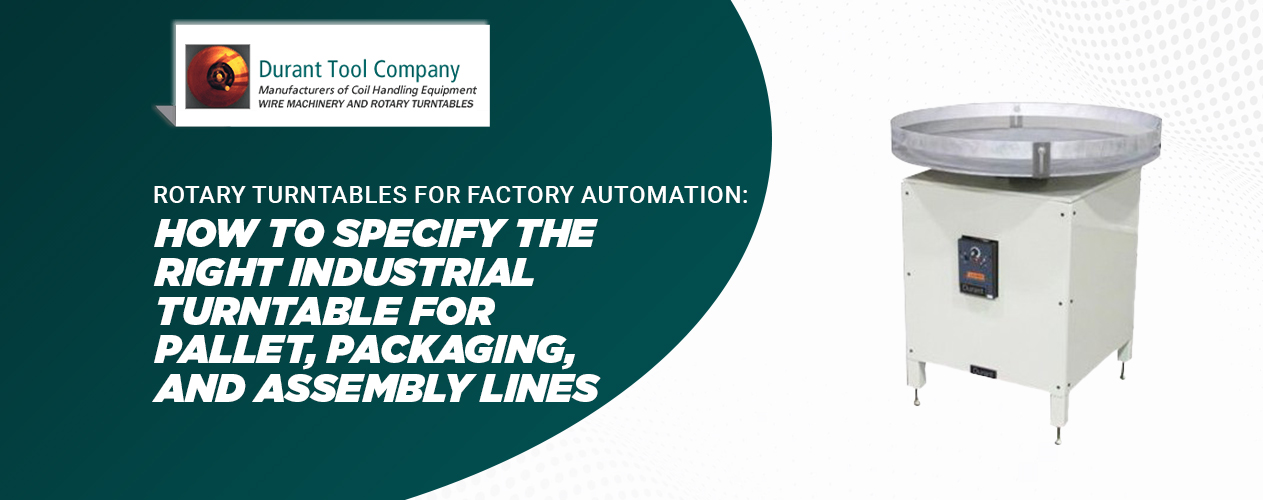
A turntable looks like the simplest machine on the plant floor. It is a round steel plate that spins. Yet the wrong one will wobble under a loaded pallet, stall halfway through a wrap cycle, or force your operators to walk around a fixture all day long. Getting the industrial rotary turntable specification right is the difference between a machine that quietly earns its keep for twenty years and one that becomes a maintenance ticket every other month.
The good news is that specifying a turntable comes down to a short list of numbers. Load. Diameter. Height. Speed. Duty cycle. Drive type. Controls. Surface. Safety. Nail those nine and the rest falls into place. Miss one, and you usually find out the hard way at 2 a.m. on second shift.
Plenty of plants start with a simple non-motorized rotating platform and only later realize they needed power, speed control, and a foot pedal. A spinning platform is one of the few machines where a $200 decision at the quoting stage can cost you thousands in throughput later.
Key Takeaways
To specify an industrial rotary turntable, you match the platform to the heaviest load it will ever carry, size the diameter to your largest footprint, then pick a rotation type and speed that fits your process. After that you choose the drive, motor, controls, surface, and safety features that suit your duty cycle and environment. Write those numbers down before you request a quote and you will get the right machine the first time.
| Spec | What to Define | Why It Matters |
| Load capacity | Heaviest load plus fixtures, with margin | Prevents deflection, wobble, and bearing wear |
| Platform diameter | Largest product or pallet footprint | Keeps the load fully supported and stable |
| Profile height | How the load gets on and off | Decides forklift, pallet jack, or hand loading |
| Rotation type | Continuous, variable speed, or indexing | Matches the machine to the process |
| Speed range | Target RPM at full load | Controls cycle time and product shift |
| Drive and bearing | Chain, belt, gear, or direct drive | Sets service life under real duty cycles |
| Motor and controls | Horsepower, voltage, pedal or panel | Determines torque and operator experience |
| Surface and finish | Anti-slip, painted, or stainless | Handles washdown, food, and outdoor use |
| Safety and integration | Brake, E-stop, guarding, PLC signals | Keeps people safe and the line in sync |
Durant Tool Company has been building turntables, coil handling gear, and factory automation equipment in Rhode Island for decades, and every turntable ships with a standard three year warranty.
What an Industrial Rotary Turntable Actually Does
An industrial rotary turntable is a load-bearing platform that rotates on a heavy spindle or bearing assembly. Some spin by hand. Some spin on a motor. All of them exist for one reason: to bring the work to the operator instead of making the operator walk around the work.
That sounds small. It is not. A welder who stops walking around a fixture saves a few seconds per pass. Multiply that across a shift and you have real minutes back.
Here is where these machines earn their keep:
- Pallet handling. Rotating a loaded pallet for wrapping, labeling, or inspection without a forklift move.
- Packaging lines. Accumulating cartons at the end of a conveyor so one person can keep up with the line.
- Assembly and welding. Turning a fixture so a tech can reach every side of a part.
- Inspection and QC. Slow, steady rotation for visual checks or camera capture.
- Display and demonstration. Rotating machinery or vehicles at trade shows and showrooms.
- Paint and finishing. Even coverage without a second operator repositioning the piece.
Turntables are widely considered one of the lowest-cost ergonomic upgrades a plant can make, because they cut down on twisting, reaching, and walking without changing the process itself.
Types of Factory Turntables and What Each One Is Built For
Not every turntable is a factory automation turntable. The category covers everything from a small display platform to a five-thousand-pound pallet wrapper. Picking the right family first saves a lot of back and forth later.
| Type | Typical Use | Powered? |
| Non-motorized high profile | Welding fixtures, hand-turned assembly, display | No |
| Motorized variable speed | Assembly, inspection, continuous rotation | Yes |
| Stretch wrap turntable | Pallet wrapping at the end of a line | Yes |
| Accumulation turntable | Carton and package buffering | Yes |
| Indexing turntable | Repeating stop positions for multi-station work | Yes |
| Pedestal and cabinet | Space-limited cells, control panel built in | Either |
| Low profile | Pallet jack loading without a ramp | Either |
A high profile unit sits taller and is designed to be moved and loaded with a forklift. A low profile unit sits close to the ground so a pallet jack can roll right on. That single choice changes how your team works around the machine every single day.
If more than one department will share the machine, spec for the toughest job on the list. Turntables are easy to over-serve and painful to under-serve.
Manual or Motorized: Which One Fits Your Line
Manual turntables cost less, need no power, and never trip a breaker. They are ideal for fixtures a person turns a few times an hour. Add a tension brake and an operator can lock the platform in place for precise work.
Motorized units take over when rotation happens constantly, when the load is too heavy to turn by hand, or when speed needs to stay consistent. A powered platform with heavy duty rotary turntables construction can turn thousands of pounds smoothly at very low RPM, which is something no human arm can do repeatably.
Ask three questions:
- How many times per hour does this thing rotate?
- Can one person turn the load safely without straining?
- Does the speed need to stay the same every cycle?
If the answers are “often,” “no,” and “yes,” you want a motor. The variable speed drive options available on modern units make it easy to dial in one speed for inspection and another for wrapping on the same machine.
How to Build an Industrial Rotary Turntable Specification in 9 Steps
This is the part worth printing out. Work through these nine items in order and you will end up with a spec sheet a manufacturer can quote accurately on the first try.
1. Start With the Real Load, Not the Product Weight
Everyone knows what their product weighs. Fewer people add the fixture, the pallet, the tooling, and the operator who occasionally steps up to reach something.
Write down three numbers:
- Static load: the total weight sitting still on the platform.
- Dynamic load: the weight while it is turning, including any shift or sway.
- Shock load: what happens when a forklift sets a pallet down a little hard.
Then add margin. A common approach is to spec at least 25 percent above your heaviest real-world load. Bearings and spindles do not fail on the average day. They fail on the worst day.
Off-center loading matters just as much. A load parked at the edge of the platform creates a tilting force on the bearing that a centered load never does. Rated capacity assumes the weight is reasonably centered, and it drops as the load moves outward. If your product always sits off to one side, say so in the quote request.
2. Size the Diameter to the Footprint, Then Add a Little
The platform should fully support the base of your load. Overhang is acceptable in some cases, but it concentrates stress at the platform edge and makes the whole assembly feel tippy.
The common North American pallet measures 48 by 40 inches. That diagonal is roughly 62 inches, which is why 60 inch and 72 inch platforms are so popular in pallet applications. A 48 inch platform will hold a standard pallet, but the corners will hang over as it spins. For wrapping, that is usually fine. For assembly work where someone leans on a corner, it is not.
Rule of thumb: For rotating pallets, a platform that covers the pallet’s short side is workable. A platform that covers the diagonal is better.
3. Choose the Profile Height and Loading Method
How does the load get on the platform? This one question eliminates half the catalog.
- High profile: Loaded by forklift. Easy to move, easy to service, taller working height.
- Low profile: Loaded by pallet jack, often with a ramp. Keeps the load closer to the floor.
- Pit mounted: Flush with the floor. Cleanest option, highest install cost.
- Pedestal or cabinet: Compact footprint, good for cells where floor space is tight.
Working height also affects ergonomics. A platform that puts the work at elbow height for a standing operator is worth specifying on purpose, not by accident.
4. Decide Between Continuous, Variable Speed, and Indexing
Three rotation types cover almost every factory job:
- Continuous rotation turns at one steady speed. Good for display, coating, and simple wrapping.
- Variable speed lets the operator dial the RPM up or down mid-process. Good for mixed products and inspection.
- Indexing stops the platform at set positions, such as every 90 or 120 degrees. Good for multi-station assembly, where a part visits several workstations in sequence.
Indexing is the option people forget to ask about and later wish they had. If your process has stations, spec indexing from the start.
5. Set the Speed Range at Full Load
RPM is where a lot of specs go sideways. A turntable rated for a certain speed empty may not hold that speed loaded, so always state your target speed and your load in the same sentence.
Typical ranges look like this:
| Application | Common Speed Range |
| Photography and inspection | Roughly 1 to 3 RPM |
| Display and demonstration | Roughly 1 to 6 RPM |
| Assembly and welding | Roughly 1 to 5 RPM |
| Stretch wrapping | Roughly 6 to 15 RPM |
Faster is not better. A tall, unstable pallet spun too quickly will shed its top layer. Many stretch wrap turntables offer a range up to around 16 RPM specifically so the operator can back the speed down for unstable loads.
6. Match the Drive and Bearing to Your Duty Cycle
Duty cycle is how hard the machine works over time. A turntable that runs eight hours straight needs different components than one that turns twelve times a day.
Drive options, in plain terms:
- Chain drive: Strong, positive engagement, no slipping. Common on heavy pallet units. A 50 pitch chain is a typical industrial choice.
- Belt drive: Quiet and forgiving, but belts stretch and can slip under heavy starting loads.
- Friction wheel: Simple and inexpensive, but it slips as the wheel wears.
- Gear or direct drive: Highest torque and precision, usually the priciest option.
Bearings follow the same logic. Light loads run fine on a simple bearing plate. Heavier and off-center loads call for a heavy spindle shaft with paired bearings or a slewing ring. If you want a closer look at how a turntable is built from the bearing up, the mechanics make the tradeoffs a lot easier to see.
Bearing life in industrial equipment is generally calculated using an L10 rating, which estimates the hours at which most units in a batch are still running. It is a statistical target, not a guarantee, which is why maintenance habits matter so much.
7. Specify the Motor, Voltage, and Control Interface
Motor sizing follows load and speed. Heavier platforms and faster rotation both push horsepower up. As a general reference, a motorized turntable for packaging work in the several-hundred-pound range often runs on a fractional horsepower motor, while units handling a few thousand pounds step up from there.
Nail down these details before you order:
- Voltage and phase. 115V single phase is common for lighter units. Heavier or continuous-duty machines often want 230V or three phase.
- Control style. Foot pedal, hand pendant, panel-mounted dial, or PLC control.
- Cord length. A short pedal cord will annoy your operator every day. Eight feet is a common standard.
- Enclosure rating. Washdown and outdoor installs need sealed enclosures.
A low voltage foot pedal is one of those small features that quietly makes a machine better. It keeps both hands free, which matters a lot on assembly and wrapping jobs.
Working through a packaging or wrapping upgrade? Durant’s stretch wrap turntables are built for pallet duty with chain drive, foot pedal control, and anti-slip tops as standard features.
8. Plan for the Surface and the Environment
The top of the platform does more work than people expect. Painted steel is the default and works well in dry manufacturing. Everything else depends on your environment.
- Anti-slip rubber cover: Keeps cartons and pallets from sliding during acceleration.
- Stainless steel construction: Required for food processing, medical, pharmaceutical, and most washdown areas.
- Custom paint: Matches plant color coding or brand standards.
- Outdoor rating: Sealed components and corrosion resistance for yards and loading docks.
If your plant washes down, do not compromise here. Water and painted carbon steel are a slow-motion argument that water always wins. Fully stainless steel motorized models exist for exactly this reason and cost far less than replacing a rusted platform in two years.
9. Build In Safety and Line Integration From Day One
Safety features are cheap when specified and expensive when retrofitted. Cover these:
- Emergency stop. A zero speed E-stop with an air brake system stops a heavy platform quickly instead of coasting.
- Adjustable tension brake. Lets an operator hold a manual platform steady during precision work.
- Pinch point guarding. Any gap between a rotating platform and a fixed frame is a hazard.
- Guarded drives. Belts and chains need covers.
- Floor anchoring. Heavy units should be anchored or clearly staged.
Integration matters too. If the turntable feeds a conveyor or works inside a cell, your controls engineer will want signals: start, stop, in-position, fault. Say that up front. Adding I/O later usually means opening a panel that was sealed at the factory.
How Much Weight Can a Factory Turntable Really Hold
This is the question that comes up first on almost every call, and the honest answer is “it depends on where the weight sits.”
Standard industrial lines commonly cover capacities from a couple hundred pounds up through several thousand. Durant’s high profile line, for example, lists standard models from 250 pounds up to 6,000 pounds, with heavy duty configurations rated as high as 12,000 pounds and special diameters available well beyond catalog sizes.
Three things change the real number:
- Load placement. Centered loads use the full rating. Edge loads reduce it.
- Load height. A tall load raises the center of gravity and adds tipping force during starts and stops.
- Acceleration. Faster starts create higher instantaneous torque demand, which effectively derates capacity.
When in doubt, describe your actual load to the manufacturer instead of picking a number from a chart. Weight, size, shape, height, and how it sits on the platform all belong in that conversation.
Duty Cycle, Cycle Rate, and Start-Stop Frequency
Continuous rotation is easy on a machine. Constant starting and stopping is not. Every start pulls peak current and puts peak torque through the drive train.
Standard industrial turntable motors are typically rated for continuous duty, but the number of start-stop cycles per minute has practical limits. Heavier and faster units generally tolerate more frequent cycling than standard-speed units, and pushing past those limits leads to motor heating and premature drive wear.
Before you quote, be ready to state:
- Degrees of rotation per cycle
- Time allowed per rotation
- Cycles per hour or per minute
- Dwell time between rotations
Those four numbers tell an engineer more about your application than almost anything else.
What Drives the Cost of an Industrial Turntable
Prices vary widely, so it helps to know which choices move the number. In rough order of impact:
- Capacity and diameter. Bigger platforms need thicker plate, larger bearings, and heavier frames.
- Motorization. Adding a drive, controller, and pedal is a meaningful step up from a manual unit.
- Stainless construction. Material cost and fabrication time both rise.
- Indexing and custom controls. Positioning hardware and PLC integration add engineering.
- Custom dimensions. Non-standard heights and diameters mean custom fabrication.
- Special features. Air brakes, powered masts, and outlets in the platform top all add cost.
Manual units sit at the low end. Motorized packaging units sit in the middle. Large custom stainless indexing tables sit at the top. Warranty coverage matters here too, because a longer standard warranty lowers the real cost of ownership even when the sticker looks similar.
Not sure which configuration fits your line? Call a Durant specialist with your load, diameter, and speed numbers and get a straight answer instead of a catalog.
Common Specification Mistakes to Avoid
Most turntable problems trace back to a handful of decisions made in a hurry:
- Specifying for today’s product only. Lines change. Build in headroom.
- Ignoring off-center loading. The number one cause of premature bearing wear.
- Choosing the wrong profile height. Nothing frustrates a team faster than a machine they cannot load easily.
- Skipping variable speed. Fixed-speed units feel limiting within months.
- Forgetting the environment. Painted steel in a washdown bay is a short-term solution.
- Leaving out controls detail. Pedal versus panel versus PLC changes the whole build.
- Underestimating cycle rate. Frequent starts wear drives faster than continuous running.
Fixing any of these after installation costs far more than asking one extra question during quoting.
Installation, Maintenance, and Service Life
A well-built industrial turntable is not a high-maintenance machine, but it is not a no-maintenance machine either.
At installation:
- Confirm the floor is level and rated for the point loads
- Anchor per the manufacturer’s instructions
- Verify voltage and phase before first power-up
- Run the unit empty, then with a light load, before full production
Ongoing:
| Task | Suggested Frequency |
| Visual inspection for wobble or noise | Weekly |
| Chain or belt tension check | Monthly to quarterly |
| Bearing lubrication | Per manufacturer schedule |
| Fastener re-torque | After break-in, then annually |
| Control and E-stop function test | Monthly |
Bolt relaxation during the first hours of operation is normal, which is why a re-torque after break-in is worth scheduling. Catch a loose fastener early and you avoid a bent platform later.
With reasonable care, a properly specified heavy duty unit will outlast several generations of the products it rotates. That is the quiet argument for spending a little more time on the spec sheet up front.
Putting the Spec Sheet Together
Before you pick up the phone, have these written down:
- Heaviest total load, including fixtures
- Largest footprint dimensions
- Load height and center of gravity
- Preferred platform diameter
- Loading method (forklift, pallet jack, hand, conveyor)
- Rotation type (continuous, variable, indexing)
- Target speed range at full load
- Cycles per hour and degrees per cycle
- Available voltage and phase
- Environment (dry, washdown, outdoor, food grade)
- Control preference (pedal, pendant, panel, PLC)
- Required safety features
That list turns a vague inquiry into a quotable project. It also protects you, because a manufacturer working from real numbers can flag problems before anything gets welded.
Conclusion
A turntable is a simple machine with a surprising number of decisions hidden inside it. A solid industrial rotary turntable specification starts with honest load numbers, matches the platform to your real footprint, and then works outward through speed, drive, controls, surface, and safety.
Do that work once and you get a machine that fades into the background of your operation, which is exactly what good equipment should do.
Take the extra hour on the spec sheet. Your maintenance team, your operators, and your throughput numbers will all thank you for it.
Ready to stop guessing and start spinning? Bring your load, diameter, and speed numbers to Durant Tool Company and get a turntable built to turn the way your line actually runs.
FAQs
What is the difference between a rotary turntable and a rotary table?
In everyday purchasing the terms overlap, but a rotary table usually refers to a precision machine tool accessory built for very fine positioning, while a turntable refers to a load-handling platform built for weight and durability. If your job is machining, ask about rotary tables. If your job is moving or presenting a load, ask about turntables.
Can an industrial turntable be installed flush with the floor?
Yes, pit-mounted installations set the platform level with the floor so pallet jacks and carts can roll straight on. The tradeoff is civil work, since the pit has to be formed, drained, and sized before the equipment arrives.
Do turntables need a dedicated electrical circuit?
Motorized units generally do, especially anything running continuously or drawing higher amperage. Confirm the full-load amp draw with the manufacturer and have an electrician verify your wire gauge and breaker sizing before installation.
How long does it take to get a custom turntable built?
Lead times vary by capacity, finish, and how much custom fabrication is involved, so standard catalog sizes typically ship faster than custom diameters or stainless builds. Ask for a lead time estimate at the same time you ask for pricing.
Can an existing manual turntable be converted to motorized later?
Sometimes, but it depends on the frame, spindle, and bearing design of the original unit. In many cases buying a purpose-built motorized model costs less than retrofitting, so it is worth pricing both paths before committing.


