 Menu
Menu

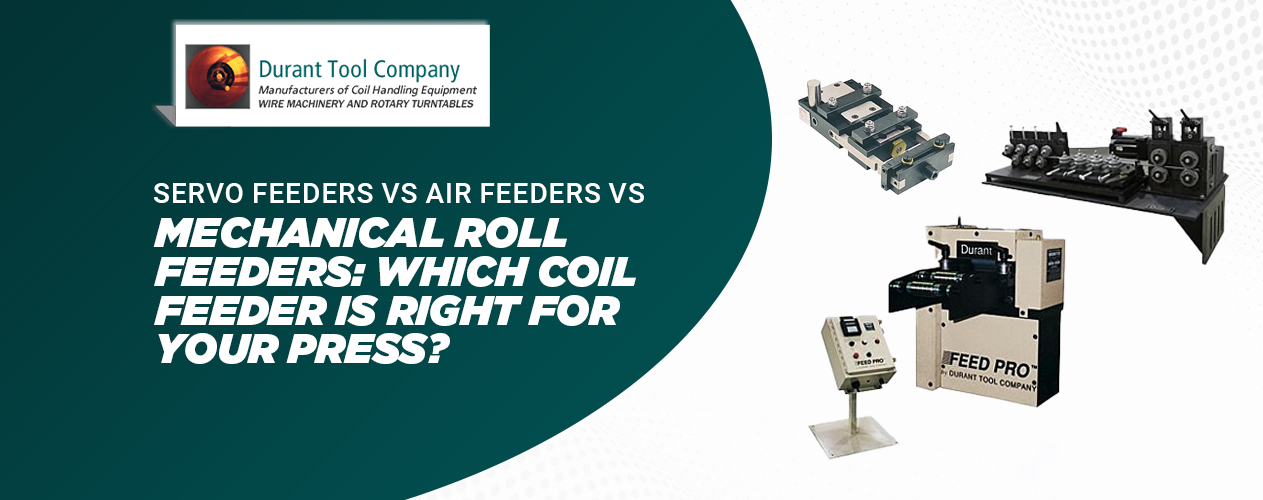
Picking the right feeder for a stamping press is one of those choices that quietly shapes your whole day on the floor. The feeder moves your metal strip into the die, hit after hit, and it sets the pace for quality, speed, and scrap.
Get it right and jobs run smooth. Get it wrong and you fight short feeds, jams, and wasted material.
A servo feeder is one of three popular ways to handle this job, sitting alongside the air feeder and the mechanical roll feeder. If you want the precision end of the spectrum, units like these flat stock servo roll feeders show how far the technology has come.
The trick is matching the feeder to your parts, your press, and your budget instead of buying on habit.
Key Takeaways
The right coil feeder depends on your speed, accuracy, budget, and how often you change jobs. Air feeders are simple and affordable for steady, lighter work. Mechanical roll feeders run very fast for fixed, high-volume jobs. Servo feeders give the best mix of accuracy, flexibility, and control for shops that run many different parts.
| Feeder Type | Best For | Accuracy | Flexibility | Upfront Cost |
| Air Feeder | Low to medium volume, simple jobs | Good (tool pilots help) | Limited | Low |
| Mechanical Roll Feeder | High-speed, fixed, long runs | High | Low (hard to change) | Medium |
| Servo Feeder | Many part types, tight tolerances | Very high | High (programmable) | Higher |
Quick context: most modern press lines move material with rollers or grippers. The big difference between feeder types is how that motion is powered and controlled.
Durant Tool Company has spent decades building coil feeding equipment for stamping shops, so the comparison below comes from the same world its machines live in every day.
What a Coil Feeder Actually Does
Before comparing the three types, it helps to picture where a feeder sits in the bigger setup. Metal usually arrives at your press as a big rolled coil. That coil has to be unrolled, flattened, and fed into the die in exact lengths. The feeder handles that last step, pushing or pulling the strip forward a set distance for each press stroke.
A full press feed coil line normally has a few stages working together:
- Decoiler (or reel): holds the coil and lets it unwind in a controlled way.
- Straightener: runs the strip through rollers to take out the curve so it lies flat.
- Feeder: moves the flat strip into the die in precise increments.
- Press and die: stamp, bend, or cut the part.
Each stage hands off to the next, so a weak link anywhere slows the whole line. If you want a deeper look at the front of the line, this guide on coil handling equipment walks through the machines that feed material to the feeder itself.
The feeder is small compared to the press, but it sets the rhythm for everything. A steady feeder means steady parts.
Now that the line makes sense, here is how each of the three feeder types gets the job done.
How an Air Feeder Works
An air feeder uses compressed air to move the strip. It works with cylinders that grip the metal, slide it forward, then release and return for the next cycle. This design has been around a long time because it is simple, sturdy, and easy to bolt onto many presses.
The basic motion goes like this:
- A clamp powered by air grips the strip.
- The cylinder pushes the strip forward to a set stop.
- The clamp releases while a second clamp holds the strip in place.
- The feed clamp returns to start, and the cycle repeats.
The feed length is set by adjusting a positive stop on the unit. That makes setup straightforward for a single job. Many shops still rely on these units for steady runs, and a maker like Durant offers a wide range of air feeders built for different widths and thicknesses.
Strengths of air feeders:
- Low upfront cost and simple design.
- Easy to install and maintain with basic shop skills.
- Reliable for lighter material and steady jobs.
- Compact and easy to add to an existing press.
Things to watch:
- Timing of the clamp and release matters a lot. If timing drifts at higher speed, the strip can slip and cause a short feed.
- The grip is often on one side, so wide or stiff material can pull unevenly.
- Changing the feed length means adjusting the stop by hand.
- The constant slamming to the stop adds wear over time.
Watch out: an air feeder leans on the stamping die’s pilots to fine-tune position. On parts with tight tolerances and no pilots, those small feed differences can show up in the finished piece.
Air feeders are not the most precise option, but for many jobs the die pilots make up for small feed differences. For simple, lower-volume work, they remain a cost-friendly pick.
How a Mechanical Roll Feeder Works
A mechanical roll feeder takes its power straight from the press. Instead of air or a separate motor, it uses a mechanical link such as a cam or a rack-and-pinion drive that connects to the press motion. As the press turns, the feed rolls turn with it in perfect step.
Because the feeder is tied to the press cycle, the timing is locked in. The feed starts and stops at set points in the stroke, no matter how fast the press runs. This is why a mechanical press feeder can move material at very high speeds with strong, repeatable accuracy. For fixed, long-running jobs, that steady rhythm is hard to beat. Shops often pair these with a straightener, and units like these roll feeders handle that combined duty.
Strengths of mechanical roll feeders:
- Very high speed for the right jobs, often well past what air units reach.
- Tight, repeatable accuracy because the feed is locked to the press.
- Few electronics to manage.
- Great for dedicated, high-volume runs that rarely change.
Things to watch:
- Changing the feed length is hard. It often means swapping gears, rolls, or linkage parts.
- There is no easy jog or inch function for threading new material.
- The feeder cannot talk to press controls or share setup data with automation.
- It works best when a press is dedicated to one part for a long time.
Mechanical roll feeds are sometimes called older technology, yet they still earn their keep on high-speed lines that stamp the same part for months at a time.
The trade-off is clear. You gain raw speed and rock-solid timing, but you give up easy changeovers and modern controls. That fits a shop running long, fixed jobs far better than one juggling short runs.
How a Servo Feeder Works
A servo feeder uses a closed-loop servo motor to drive the feed rolls. The motor gets a signal from the press, then moves the strip a programmed distance with very fine control. Instead of a hand-set stop or a press-driven cam, a small controller tells the motor exactly how far to go.
This is where the electronic servo roll feeder stands apart. The control package lets an operator type in feed length, speed, and timing on a keypad or screen. Change the job and you change the numbers, not the hardware. That alone saves a lot of setup time in shops that run many part types.
Strengths of servo feeders:
- High accuracy with very repeatable feed lengths.
- Programmable settings, so changeovers are quick and tool-free.
- Self-checks, auto-correction, and the ability to link with automation.
- Force sensing that can catch a misfeed and pull back before the die gets hit.
- Low maintenance on the feed body, with sealed bearings and a non-stretch belt on many models.
Things to watch:
- Higher upfront cost than an air unit.
- More parts to care for over time, like the motor, belt, encoder, and software.
- Operators may need a bit more training to use every feature.
One of the most valuable servo features is force sensing. If the feeder senses a spike in the force needed to move the strip, it can stop and back up to the last good position. That single feature can save thousands in broken tooling.
Servo feeders cover a wide range of work. Many precision servo feed models handle thin or thick stock, narrow or wide strips, and even soft materials like foam or paper. For shops that value flexibility and tight control, they have become the go-to choice on a modern line.
Need help sizing a servo feed to your exact width, thickness, and press? Durant Tool Company builds a deep lineup of electronic servo feeds and can match a model to your application.
Side by Side: Accuracy, Speed, Cost, and Upkeep
It helps to see the three feeders lined up on the points that matter most on the floor. The table below keeps it simple. Use it as a starting point, then weigh the details for your own shop.
| Factor | Air Feeder | Mechanical Roll Feeder | Servo Feeder |
| Accuracy | Good, helped by pilots | High, locked to press | Very high, programmable |
| Top Speed | Lower to medium | Very high | High |
| Feed Length Changes | Hand-set stop | Hard, swap parts | Easy, type it in |
| Maintenance | Simple, basic skills | Few electronics | More parts, some software |
| Upfront Cost | Low | Medium | Higher |
| Automation Link | None | None | Yes |
| Best Fit | Simple, steady jobs | Fixed, fast, long runs | Many parts, tight specs |
A few takeaways jump out. Air feeders win on price and simplicity. Mechanical feeders win on raw speed for fixed work. Servo feeders win on flexibility and control. If you want a closer look at how the numbers play out over the life of a machine, this breakdown of accuracy, speed, and total cost compares the air and servo paths in more depth.
Cost is the trickiest part of the choice. A low sticker price can hide higher long-term costs if a feeder slows changeovers or makes scrap. A higher price can pay back fast if it keeps a busy line running clean. The right answer depends on how your shop actually works.
Choosing Between a Servo Feeder, Air Feeder, and Mechanical Roll Feeder
This is the heart of the decision. There is no single best feeder for every shop. The smart move is to score your needs against the points below, then see which type lines up. Here are the main factors to weigh before you buy.
- Production volume and run length. Long, steady runs of the same part favor a mechanical roll feeder for its speed. A mix of shorter jobs favors a servo feeder for fast changeovers. Lower, simpler volume can do fine with an air feeder.
- Accuracy and tolerance needs. Tight, no-pilot parts call for the repeatable precision of a servo feeder. Looser parts with good die pilots can run well on an air feeder.
- Press speed. If you push very high strokes per minute on one fixed job, a mechanical feeder shines. For high but flexible speed, a servo keeps pace while staying programmable.
- Material thickness and width. Thicker or wider stock needs more pulling force and steady grip. Match the feeder model to your heaviest and widest material, not just the average.
- Changeover frequency. The more often you switch parts, the more a servo feeder pays off. Tool-free setting changes save real hours over a year of mixed work.
- Upfront budget versus long-term cost. Air feeders cost the least to buy. Servo feeders cost more upfront but can lower scrap and downtime. Add up both sides before deciding.
- Maintenance skills on hand. Air feeders fit shops that want simple upkeep. Servo feeders ask for a bit more comfort with motors and controls.
- Automation and data needs. If you want the feeder to share setup data, store job recipes, or link with other line gear, a servo feeder is the only one of the three built for it.
- Floor space and install. All three can be compact, but check the mounting and control cabinet needs against your press and floor layout before you commit.
Walk through these one at a time and a clear leader usually appears. Many shops even run a mix. They keep air feeders on smaller jobs and put servo units on the high-precision lines. There is nothing wrong with using the right tool for each press instead of forcing one type everywhere.
If your jobs change often or your tolerances are tight, lean servo. If you run one fast part for the long haul, lean mechanical. If you run simple, steady work on a budget, an air feeder may be all you need.
Ready to match a feeder to your press? Reach out to Durant Tool Company for sizing help and a quote built around your real production needs.
Where Each Feeder Fits Best
Sometimes the easiest way to choose is to picture the shop. Here are a few common scenarios and the feeder that tends to fit each one.
- A small shop stamping simple brackets in low volume. An air feeder keeps the cost down and the setup easy.
- A high-speed line stamping the same lamination part all year. A mechanical roll feeder delivers the speed and steady timing.
- A job shop running dozens of different parts each month. A servo feeder makes quick, tool-free changeovers and protects tight tolerances.
- A line stamping costly tooling with no pilots. A servo feeder’s force sensing helps guard against misfeeds and broken dies.
- A plant moving toward automation and data tracking. A servo feeder links into the larger system in ways the other two cannot.
These are general patterns, not strict rules. Your exact parts, press, and goals always have the final say. Still, seeing your shop in one of these pictures can point you in the right direction fast.
Common Mistakes Shops Make When Choosing
Even seasoned shops slip up when picking a feeder. Most of the trouble comes from buying on habit or price alone instead of looking at the full job. Here are the missteps that cause the most regret.
- Sizing for the average job, not the toughest one. A feeder that handles your common stock may struggle with your thickest or widest material. Always size to your hardest job so you are never stuck.
- Ignoring changeover time. A cheap feeder can cost a lot in lost hours if every job switch means hand-tweaking a stop. Add up your yearly setups before you decide that a low sticker price is the best deal.
- Skipping the straightener question. A feeder cannot fix material that is not flat. Coil set and curve will fight even a great feeder, so plan the straightening step as part of the buy.
- Overlooking force on wide stock. Wide or stiff strips need balanced pull. A single-side grip can bind, which leads to scrap and possible die damage.
- Forgetting about future growth. The part mix you run today may not match next year. If you expect more variety, the flexibility of a servo unit can save a painful upgrade later.
Smart move: talk to a feeder maker about your full line, not just the feeder. The decoiler, straightener, and lubricator all shape how well the feeder performs, and a matched setup beats a pile of mismatched parts.
A little planning up front prevents most of these headaches. Look at your real production, not just the easy days, and the choice gets much clearer.
What About Lubrication and Upkeep?
One factor cuts across all three feeder types, and that is upkeep. No matter which feeder you pick, good maintenance keeps it accurate and fast. Lubrication is a big part of this. Too much lube creates drag between the strip and the feed rolls or liners, which can throw off the feed. Too little leads to wear and rough running.
Many shops use a controlled lubricator that lays down a light, even mist of oil and pulls off the extra. That keeps the material coated just right without making a mess or dragging on the feed. Pair that with regular checks of seals, belts, and rolls, and your feeder will hold its accuracy for a long time. Simple habits like clean air for pneumatic units and routine inspection for servo systems go a long way toward steady, low-scrap production.
Conclusion
Choosing a coil feeder comes down to honest answers about your own shop. A servo feeder brings precision, flexibility, and smart controls that fit modern lines running many parts.
An air feeder offers a simple, budget-friendly path for steady, lighter work. A mechanical roll feeder delivers raw speed and locked-in timing for fixed, high-volume jobs. None of them is wrong.
Each one is the right pick for a certain kind of work, and the best choice is the one that matches your parts, your press, and your plans for growth.
When you are ready to put the right feeder to work, Durant Tool Company can help you size, choose, and run a coil line that keeps your press humming.
FAQs
Can I add a servo feeder to an older press?
Yes, in most cases a servo feeder can be mounted to an existing press as long as the mounting and signal connections are set up correctly. A feeder supplier can help confirm the fit for your specific press and material.
Do I need a straightener with my feeder?
Often yes, since coil stock usually keeps a curve from being rolled. A straightener flattens the strip so it feeds cleanly into the die, and some feeders come paired with one in a single unit.
What is pilot release and why does it matter?
Pilot release briefly loosens the feeder’s grip so the die’s pilot pins can pull the strip into its exact spot. It matters because it lets the tooling fine-tune position and helps protect both the part and the die.
Can air feeders handle thick material?
Some air feeder models are built for thicker stock with higher pulling capacity, but very thick or wide material is usually better suited to a roll feeder. Match the model’s rated thickness and width to your heaviest job.
How long do these feeders last?
With clean air, regular seal checks, and good upkeep, all three feeder types can run for many years in a busy shop. Proper lubrication and routine maintenance have the biggest effect on how long a feeder lasts.


