 Menu
Menu

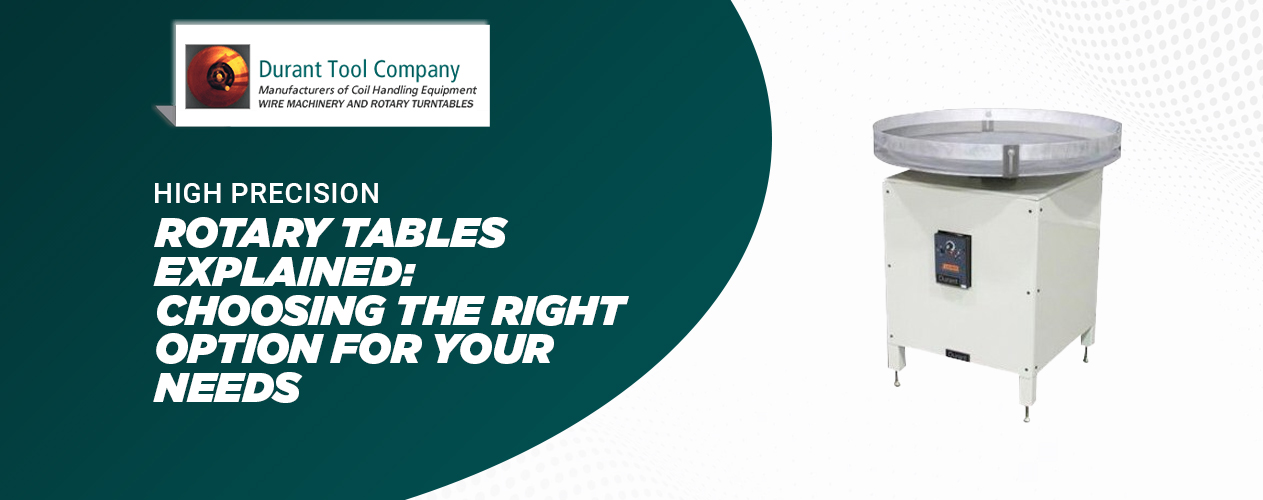
Precision matters in every machining job. A tiny error in angle or positioning can ruin a part, slow production, and cost money. That is why shops across the country rely on a high precision rotary table to keep their work accurate and repeatable.
These tools rotate a workpiece around a fixed axis so you can drill, mill, or cut at exact angles without re-clamping. They save time, reduce mistakes, and open the door to complex geometries.
Before you pick one, it helps to know the cabinet turntable and rotary table options available and how each type fits different jobs.
Key Takeaways
The best high precision rotary table is the one that matches your load, your accuracy needs, and how often you run the machine. Some tables are built for light, fast work. Others handle heavy cutting. Picking the right one starts with knowing your application and your space.
| Factor | What to Look For |
| Accuracy | Measured in arc seconds; lower is better |
| Drive Type | Worm gear, direct drive, or hydrostatic |
| Load Capacity | Match to your heaviest workpiece |
| Axis Orientation | Horizontal, vertical, or tilting |
| Control Method | Manual or CNC |
| Duty Cycle | Light, medium, or heavy-duty |
| Maintenance Needs | Check lubrication and bearing type |
For over 75 years, Durant Tool Company has built American-made rotary and turntable equipment trusted by manufacturers nationwide.
What Is a High Precision Rotary Table?
A rotary table is a work-positioning device. It holds a part on a flat disc and spins that disc around a central axis. The operator or a CNC system controls the rotation in very small, exact steps.
In high precision models, the steps are measured in arc seconds. One arc second is 1/3,600 of a degree. That level of control lets shops produce parts with tight tolerances, smooth contours, and evenly spaced features.
These tables are common in milling, drilling, grinding, inspection, and assembly. They turn a standard 3-axis machine into a 4-axis system, which opens up more complex work without buying a whole new machine.
Core Components That Drive Accuracy
Every rotary table has a few key parts that determine how well it performs. Knowing them helps you compare models with confidence.
- Base and Mounting: A solid base keeps the table stable during cutting. T-slots or clamp points secure the workpiece.
- Rotating Disc (Faceplate): The precision-machined surface that holds the part.
- Drive Mechanism: Worm gear, direct drive, or roller cam. This controls how smoothly and accurately the table turns.
- Bearings: Mechanical, air, or oil hydrostatic. Bearings set the limits on friction, load, and lifespan.
- Locking or Braking System: Keeps the table fixed when the cut is happening.
- Encoder or Dividing Plate: Provides position feedback so the operator knows exactly where the part is.
When these parts are built to tight standards, the table can hold accuracy for years.
Types of High Precision Rotary Tables to Consider
Here is where the selection gets interesting. There are several rotary table styles, each suited for different jobs. Below are the main types you will run into when shopping.
1. Manual Rotary Tables
Manual tables use a handwheel connected to a worm gear. The operator turns the wheel to position the part. These are affordable and great for small shops doing occasional indexing work.
Accuracy usually ranges from 30 to 60 arc seconds. They work well for drilling bolt circles, light milling, and small-batch production.
2. CNC Rotary Tables
CNC models plug into your machine’s controller and act as a true 4th axis. They run automatically through programmed code. Positioning is fast and very repeatable, often within a few arc seconds.
Shops handling aerospace, medical, or mold work lean on CNC tables for their speed and consistency.
3. Worm Gear Rotary Tables
This is the most common drive type. A worm and worm wheel provide high torque and strong holding force. Ratios like 40:1, 72:1, or 90:1 give fine control over rotation.
Worm gear tables handle medium to heavy cutting loads and offer a good balance of cost and performance.
4. Direct Drive Rotary Tables
Direct drive tables use a torque motor connected straight to the faceplate. There are no gears, so there is zero backlash. Speed and resolution are excellent.
These work best for light cutting, high-speed indexing, and jobs where dynamic accuracy matters, like contour milling or semiconductor work.
5. Tilting Rotary Tables
Tilting tables add a second rotational axis. The table tilts up to a set angle while still rotating. This enables true 5-axis machining on parts with compound angles.
They are a go-to for aerospace components, turbine blades, and complex mold work.
6. Air-Bearing Rotary Tables
Air-bearing designs float the rotating disc on a thin cushion of compressed air. There is no metal-to-metal contact, so friction is almost zero. Accuracy stays stable for decades.
These are top picks for metrology, optics, and ultra-precision grinding where cleanliness and repeatability are critical.
7. Hydrostatic (Oil) Rotary Tables
Oil hydrostatic tables float on a thin layer of oil. They handle heavy loads with exceptional stiffness and run very smoothly. Grinding and heavy finishing jobs benefit most from this design.
8. Horizontal and Vertical Rotary Tables
Mounting orientation affects what kind of cuts you can make. Precision tables set up horizontally rotate parts around a vertical axis, great for flat top-down milling. Vertical mounting rotates around a horizontal axis, useful for edge work and between-centers setups. For guidance on building or adapting motorized setups, this guide on how to build a motorized turntable offers helpful context.
9. Heavy-Duty Industrial Rotary Tables
For big parts, heavy cutting, or large assemblies, you need a table built for weight and torque. Heavy-duty models support thousands of pounds and keep moving reliably under stress. Durant’s heavy-duty industrial turntable options show how rugged construction and large diameters support these jobs.
Durant Tool Company manufactures custom rotary turntables with load capacities up to 12,000 lbs., built for factory automation and heavy industrial use.
Key Factors When Choosing Your Rotary Table
Once you know the types, narrow your choice by focusing on the specs that match your shop.
Accuracy Requirements
Ask yourself how tight your tolerances really are. Aerospace and medical work usually need a few arc seconds. General machining can accept 30 to 60 arc seconds. Paying for more accuracy than you need wastes money.
Load Capacity
Weigh your heaviest workpiece plus any fixtures. Always pick a table rated above that total. Running a table near its limit shortens its life.
Duty Cycle and Frequency of Use
A table running 24/7 in production needs better bearings and a stronger drive than one used a few times a week. Match the build quality to the workload.
Space and Machine Compatibility
Measure your machining center’s work envelope. A tall rotary table can eat into your Z-axis travel. Low-profile designs help on compact VMCs.
Control System
Decide if you want manual operation, stand-alone indexing control, or full CNC integration. Each choice changes the price and the complexity of the setup.
Common Applications Across Industries
High precision rotary tables show up almost everywhere parts need accurate rotation.
- Aerospace: Engine housings, blades, and structural parts with complex geometries.
- Medical Devices: Surgical tools and implants requiring tight, repeatable positioning.
- Automotive: Gears, housings, and custom components.
- Mold and Die: Contoured cavities and multi-face machining.
- Metrology and Inspection: Measuring parts with micron-level accuracy.
- Factory Automation: Indexing stations, assembly lines, and packaging systems.
- Food and Medical Processing: Stainless steel turntables for wash-down environments.
The range is wide because the core benefit, controlled rotation, applies to so many processes.
Ready to find the right rotary or turntable solution? Contact Durant Tool Company today for expert advice and competitive pricing.
Maintenance Tips to Protect Your Investment
A rotary table is a long-term investment. Simple upkeep keeps it accurate for years.
- Clean regularly. Chips and coolant can grind into bearings and seals.
- Check lubrication. Follow the manufacturer’s schedule for grease or oil.
- Inspect the worm gear. Look for wear or backlash. Adjust or replace as needed.
- Verify calibration. Use a precision level and indicator to check runout every few months.
- Protect from overload. Never exceed rated capacity, even briefly.
- Store properly. Cover the table when not in use to keep debris off the surface.
A well-maintained table holds its accuracy, and that saves time and scrap in the long run.
Conclusion
Picking the right high precision rotary table comes down to matching the tool to the work. Think about accuracy, load, drive type, and how often the table will run. With the right choice, you get better parts, faster cycle times, and fewer headaches on the shop floor.
Whether you need a compact unit for light indexing or a heavy-duty turntable built for thousands of pounds, the right partner makes all the difference.
Ready to upgrade your operation with American-built precision? Talk to the team at Durant Tool Company and find the rotary solution that fits your shop.
FAQs
How much does a high precision rotary table cost?
Prices range widely, from a few hundred dollars for small manual units to tens of thousands for CNC direct-drive or air-bearing models. The final cost depends on size, accuracy, and drive type.
Can I add a rotary table to my existing CNC machine?
Yes, most modern VMCs and HMCs can accept a rotary table as a 4th axis. You will need to confirm that your controller supports the extra axis and that the table fits within your work envelope.
What is the difference between a rotary table and an indexer?
A rotary table offers continuous rotation and can stop at any angle. An indexer is designed to stop at fixed, preset positions. Both are useful, but rotary tables offer more flexibility.
How long do high precision rotary tables last?
With proper care, mechanical worm gear tables often last 10 to 20 years. Air-bearing tables can last several decades because they have no contacting wear parts.
Do I need a special fixture to hold my workpiece?
Most rotary tables come with T-slots for standard clamps, but some jobs benefit from custom fixtures or chucks. Matching the fixture to the part improves accuracy and safety.


