 Menu
Menu

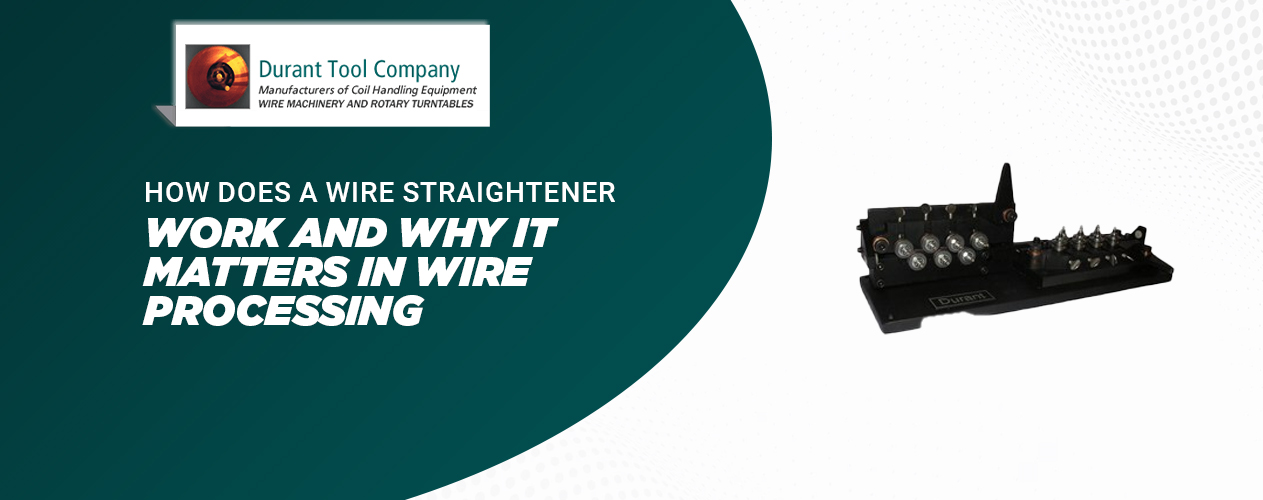
Wire arrives at most factories the same way: tightly coiled, full of memory, and bent in every direction the spool forced it into. Before that wire can become a spring, a fence, an electrical lead, or a stamped automotive part, it has to be made straight. That sounds simple. The reality on the shop floor is anything but.
A coiled wire fights back. It twists, springs, and curls the moment you try to feed it into the next machine.
The fix is a small but mighty piece of equipment called a quick adjust wire straightener, and it is doing more work behind the scenes of manufacturing than most people realize.
The math behind making something perfectly straight is far stranger than it looks from the outside.
Key Takeaways
A wire straightener works by passing coiled wire through a series of offset, grooved rollers that bend the wire back and forth in opposite directions. This controlled flexing breaks the internal “memory” left by the spool and forces the wire into a straight, uniform shape. It matters because nearly every downstream process in wire manufacturing, from cutting to forming to welding, depends on perfectly straight, stress-free wire feeding the line.
| What You Need to Know | Quick Answer |
| What it does | Removes bends, twists, and coil memory from wire |
| How it works | Offset rollers flex wire in alternating directions to release stress |
| Common roller setup | V-grooved or U-grooved rollers, often arranged in two perpendicular planes |
| Adjustment method | Thumb screws, micrometer screws, or quick-set knobs adjust roller pressure |
| Wire types handled | Round, flat, square, copper, aluminum, mild steel, stainless, spring steel |
| Industries that use it | Automotive, construction, electrical, fasteners, springs, fencing, mesh |
| Why it matters | Sets the foundation for accurate cutting, forming, and clean final products |
A quality wire straightener is the kind of machine you only notice when it’s working badly. Durant Tool Company has been building reliable wire straighteners for manufacturers who need their lines to stay quiet, fast, and accurate.
What a Wire Straightener Actually Does
A wire straightener is a precision tool that takes coiled or bent wire and turns it into straight, uniform stock that other machines can work with. The job sounds easy. The science behind it is not.
When wire is drawn and wound onto a spool, the metal “remembers” that curve. This is called coil memory or residual stress. If you simply uncoiled the wire and tried to feed it into a cutter or a spring former, it would arrive curved and inconsistent, and your finished parts would be off by millimeters or worse.
The wire straightener solves this in a clever way. Instead of trying to flatten the wire by squeezing it, it flexes the wire repeatedly in opposite directions. Each flex pushes the metal slightly past its elastic limit, breaking the memory and resetting the wire to a neutral, straight state.
The result is wire that:
- Feeds smoothly into the next machine
- Cuts at consistent lengths
- Holds tighter tolerances during forming and bending
- Produces less scrap and fewer rejects
Good to Know: The “memory” inside a coil is not damage. It is the natural elastic behavior of metal. A wire straightener does not destroy the wire. It just convinces the metal that being straight is the new normal.
The Core Components Inside a Wire Straightener
Different brands and models look different on the outside, but most wire straighteners share the same set of internal parts. Once you understand these, the rest of the machine starts to make sense.
Frame or Roller Plate. The rigid base that holds everything in place. It must stay completely fixed, because any movement in the frame transfers straight into the wire as a defect.
Rollers (or Roll Bearings). These are the small grooved wheels that actually do the straightening. They come in various groove shapes, with V-grooves and U-grooves being the most common. The number of rollers can range from three on a basic unit to seven or more per plane on a high-precision machine.
Adjustment Screws. These set the depth and pressure of each roller. They might be thumb screws, hex set screws, or precision micrometer screws depending on the machine grade.
Wire Guides. Small entry and exit guides that align the wire properly so it enters the rollers at the correct angle.
Mounting Hardware. Brackets or pivot points that secure the straightener to a workbench, a feeder line, or an uncoiler.
Every wire straightener, from a small handheld unit used in jewelry making to a heavy industrial machine running at high speeds, follows this same basic blueprint.
How Does a Wire Straightener Work, Step by Step
Here is the part that surprises most people. A wire straightener does not “press” the wire flat. It bends the wire on purpose, several times, in a very specific pattern.
The process breaks down into clear stages.
- Entry point. The coiled wire is pulled off an uncoiler or pay-off reel. It enters the wire straightener through a guide that aligns it with the first roller.
- First roller contact. The first roller in the line presses down on the wire with significant force. This deep first bend deliberately overpowers the original coil set. It pushes the wire past its elastic limit so the internal stress starts to break down.
- Alternating rollers. The wire then passes through a series of rollers that are offset above and below the wire path. Each roller bends the wire in the opposite direction of the one before it.
- Decreasing pressure. As the wire travels through the line, each roller applies slightly less pressure than the last. The bends get smaller and smaller.
- Multi-plane straightening. On two-plane and four-plane machines, a second set of rollers is set at right angles to the first. This handles the side-to-side curvature that the first plane cannot reach.
- Exit point. By the time the wire leaves the final roller, it has been flexed many times in shrinking arcs. The internal stress is gone. The wire comes out straight, smooth, and ready for the next machine in the line.
Pro Tip: The first roller does the heaviest work. If your wire is coming out wavy or curved at the exit, the problem is almost always at the entry side, not the exit side. Tighten the first one or two rollers before touching anything else.
This alternating bend method is the heart of how every wire straightener works. The exact number of rollers, the spacing, and the materials change with the machine. The principle does not.
How to Use a Wire Straightener: A Practical Operator Guide
This is the section operators come back to. Knowing how to use a wire straightener correctly is what separates a clean, productive line from one that scraps half its output. The exact steps vary by machine, but the core procedure stays consistent across most setups.
Here is a clear, practical walkthrough.
1. Mount the Machine on a Stable Surface
A wire straightener that wobbles will never deliver straight wire. Bolt it down to a sturdy workbench, frame, or feed line. The frame must be rigid. Any flex in the mounting transfers straight into the wire as waves or kinks.
2. Match the Roller Size and Groove to the Wire
Before you do anything else, confirm that the roller groove matches the diameter and shape of your wire. A 3 mm round wire needs a 3 mm round groove, not a 4 mm one. The wrong groove leaves the wire loose, and a loose wire is an unstraight wire.
Check that:
- The groove size matches the wire diameter
- The groove shape (V or U) suits your wire profile
- All rollers are clean, free of debris, and spinning freely
3. Loosen All Rollers Before Threading
Back off every adjustment screw before you feed the wire in. If you try to thread wire through pre-loaded rollers, you will scratch the wire, jam the line, or both. Open the machine fully, thread the wire through, then start tightening.
4. Feed the Wire Through All Rollers
Pull the wire from the uncoiler through the entry guide, between every roller in sequence, and out the exit guide. Keep light tension on the wire as you thread it so it does not bunch up between rollers.
5. Set the First Rollers Tight
Start with the first roller (the one closest to the uncoiler). Tighten it down so it presses firmly on the wire. This is the roller that does the work of breaking the coil memory, so it needs real pressure, not a gentle touch.
6. Apply Decreasing Pressure Down the Line
Each roller after the first should be slightly less tight than the one before it. The pattern should be a gradual ease-off from heavy bend to gentle bend to neutral by the time the wire exits.
Heads Up: Over-tightening every roller is the most common rookie mistake. It does not make the wire straighter. It makes the wire scratched, work-hardened, and sometimes wavy. Less is more once you get past the first roller.
7. Run a Test Length and Check Straightness
Feed a short test piece, around half a meter to a meter, through the straightener. Set it on a flat surface and look down its length. Roll it across the bench. If it rolls smoothly and lies flat, you are dialed in. If you see a curve, identify which direction it bends and adjust accordingly.
8. Fine-Tune Based on the Result
Use this simple troubleshooting logic:
- Wire bends down at the exit: Loosen a top roller near the exit, or tighten a bottom roller near the exit
- Wire bends up at the exit: Reverse the above
- Wire is wavy or rippled: First rollers are too tight. Back them off slightly
- Wire still has coil memory: First rollers are not tight enough. Increase pressure at the entry side
Once your settings are right, the line should run smoothly and produce consistent output without further fuss.
Durant offers a full lineup of precision wire straighteners built to handle round, flat, and shaped wire across a wide range of diameters, with adjustable rollers designed to make setup quick and repeatable.
How to Adjust a Wire Straightener for Different Wire Types
Adjusting for different wires is where operator experience really shows. Knowing how to adjust a wire straightener is the skill that separates a good line from a great one. Different wire materials behave very differently under the same roller pressure.
Here is how the major wire types respond.
Mild Steel Wire
Mild steel is forgiving. It bends easily and holds its new shape well. Use moderate pressure on the first rollers and a gradual ease-off down the line. Most general-purpose settings work fine here.
High-Carbon and Spring Steel Wire
Spring steel and high-carbon wire have heavy spring-back. They want to return to their original shape, which means you need significantly more pressure on the first rollers to break the memory. Expect to set the entry rollers tighter than you would for mild steel.
Stainless Steel Wire
Stainless work-hardens fast. If you over-bend it, you will fatigue the wire and risk breakage. Use a gentler bend pattern, with multiple rollers each applying smaller corrections rather than one heavy bend up front.
Copper and Aluminum Wire
These soft, non-rebound metals barely fight back. The wire wants to stay where you put it. For copper and aluminum, you can run the rollers in nearly a straight line, with very light pressure. Heavy bending will deform the wire and leave permanent marks.
Flat or Shaped Wire
Flat strip and shaped wire (square, hex, D-shape) need rollers with matching profiles. A round-groove roller will not straighten flat wire well. The rollers must contact the wire across the full profile, not just at the edges.
The table below gives a quick reference.
| Wire Type | First Roller Pressure | Bend Profile | Notes |
| Mild Steel | Moderate | Gradual ease-off | Forgiving, easy to set |
| Spring / High-Carbon | Heavy | Strong first bend | High spring-back, needs deep first cut |
| Stainless Steel | Light to moderate | Many small corrections | Work-hardens easily |
| Copper / Aluminum | Very light | Nearly straight | No spring-back, soft surface |
| Flat or Shaped | Match profile | Profile-specific | Use matching groove rollers |
Quick Tip: Always change one roller at a time when adjusting. If you tweak three rollers at once and the wire gets worse, you have no idea which one caused it. Patience pays off.
Single-Plane vs Two-Plane vs Multi-Plane Wire Straighteners
Not every wire straightener has the same number of roller planes. The choice depends on what you are straightening and how perfect it needs to be.
Single-Plane Wire Straighteners. These have one row of offset rollers working in a single direction. They handle simple straightening jobs where the wire only has curvature in one plane (up-down or side-to-side). Single-plane units are common for hobby use, jewelry making, and light wire applications.
Two-Plane Wire Straighteners. These are the workhorses of industrial wire processing. They have two sets of rollers set at 90 degrees to each other. The first plane handles vertical curvature. The second plane handles horizontal curvature. Most coiled wire has both, so a two-plane unit is the practical minimum for serious production work.
Four-Plane and Multi-Plane Wire Straighteners. These add additional roller sets at angles between 0 and 90 degrees. They are used for high-precision applications like medical wire, aerospace components, and fine-gauge spring wire where the wire must be near-perfect with no detectable bow or helix.
In most factories that handle mid to high volumes of round or flat wire, a two-plane setup hits the sweet spot of cost, capability, and ease of use.
Why It Matters in Wire Processing
This is the question that gets to the heart of the topic. A wire straightener is a relatively simple machine, but its impact on the rest of the wire processing line is huge.
It Sets the Standard for Every Process Downstream
Every machine after the straightener depends on getting wire that is truly straight. Cutting machines need straight wire to deliver consistent lengths. CNC wire benders need it to hit accurate angles. Spring coilers need it to produce springs that meet spec. Welders need it for clean, repeatable joints.
If the wire is even slightly curved when it leaves the straightener, the error compounds at every step. A 1 mm curve over a meter of wire might not look like much. Multiply that across thousands of parts a shift, and you have a serious quality problem.
It Reduces Material Waste and Scrap
Bent or stressed wire produces more rejects. Straightened wire produces fewer. For a manufacturer running thousands of meters a day, even a small reduction in scrap rate translates to real savings.
It Improves Wire Durability
The flexing process inside a wire straightener actually helps the wire perform better in service. By relieving internal stress, the straightener leaves the wire more dimensionally stable and less prone to fatigue. You can read more about how wire straighteners boost durability and the science behind the stress-relief effect.
It Speeds Up the Entire Line
Straight wire feeds faster, jams less, and lets cutting and forming machines run at higher speeds. The straightener is often the bottleneck that decides how fast the entire line can run safely.
It Protects Downstream Equipment
A coiled, tangled, or stressed wire being forced into a cutter or bender puts mechanical strain on those machines. Over time, this wears out blades, dies, and feed mechanisms. A clean, straight wire is gentler on every piece of equipment it touches.
Why It Matters: Wire straightening is the unglamorous step that makes everything else look good. Skip it or do it poorly, and the problem shows up as rejects, downtime, or premature equipment wear, sometimes weeks later.
It Improves the Final Product’s Appearance
Many finished wire products are visible: fence panels, display racks, shopping baskets, automotive springs in clear assemblies, decorative components. Straight wire simply looks more professional and signals quality to the end customer.
Common Mistakes Operators Make
Even experienced operators slip up when setting a wire straightener. Watching out for these issues saves time and material.
- Over-tightening every roller. Pressure should taper, not stack. Heavy pressure everywhere creates work-hardening and waves
- Skipping the test length. Trying to dial in by eye while running production wastes wire. Always run a short test piece first
- Using the wrong groove size. A groove larger than the wire lets the wire wander. A groove smaller than the wire scratches and deforms it
- Leaving the frame loose. A wobbly machine produces wobbly wire. Bolt the unit down properly
- Ignoring roller wear. Rollers wear over thousands of meters. A worn groove will not deliver the same straightness it did when new
- Forgetting to clean. Metal dust, oil residue, and broken wire bits build up in the grooves. Clean them regularly
- Adjusting too many things at once. One change at a time, then test. Trying to fix everything simultaneously turns into guesswork
Keep in Mind: A wire straightener responds best to small, deliberate adjustments. If you find yourself making big swings to roller pressure, something else is wrong. Check the wire stock, the uncoiler tension, and the mounting before you blame the straightener.
If your line is producing wavy, curved, or inconsistent wire and you are tired of guessing at the cause, reach out to Durant Tool Company for a straightener that actually fits your application.
Manufacturers tend to favor robust, easy-to-maintain machines that handle a wide range of wire diameters. The reason is practical. A small or mid-size shop often runs many different jobs across the same equipment, so flexibility and quick changeover matter more than ultra-high speed.
Pairing a good straightener with the right uncoiler also makes a big difference. The choice between pedestal vs cabinet-mounted uncoilers affects how cleanly the wire feeds into the straightener, which in turn affects how clean the output is. The two pieces of equipment work best when they are matched to the same job.
Fun Fact: Wire straightening as a process is said to be almost as old as drawn wire itself. Early blacksmiths would roll wire between flat stones or wooden blocks to coax it straight. The modern roller-based machine is just a refined, repeatable version of that same basic idea.
A Quick Comparison of Roller Configurations
Different jobs call for different roller setups. Here is a simple way to think about it.
| Configuration | Number of Rollers | Best For | Precision Level |
| 3-roller single | 3 | Light hobby work, simple straightening | Basic |
| 5-roller single | 5 | Light industrial, small wire diameters | Moderate |
| 7+ roller single | 7 or more | Higher precision single-plane jobs | High |
| 5-roller two-plane | 10 (5+5) | General industrial wire processing | High |
| 7-roller two-plane | 14 (7+7) | Tight-tolerance production | Very high |
| Multi-plane | Varies | Aerospace, medical, precision spring wire | Excellent |
More rollers per plane generally means tighter straightness, smoother operation, and better tolerance holding. They also cost more and take longer to set up.
Conclusion
A wire straightener is a small machine doing a big job. It takes coiled, stressed, memory-laden wire and turns it into the straight, predictable stock that every other machine in the line needs to do its work. Knowing how to use a wire straightener correctly, from the first roller pressure to the final fine-tune, is what keeps a wire processing line running clean, fast, and profitable.
The mechanism is clever, the science is simple, and the impact on quality is enormous. Whether you are setting up a wire mesh plant, a spring shop, or a fastener line, the time you invest in understanding your straightener will pay for itself many times over in fewer rejects, less scrap, and longer equipment life.
If you are ready to get straight wire on the first pass instead of the third, the team at Durant Tool Company builds wire straighteners that do their job quietly and let you get back to running your line.
Frequently Asked Questions
How often should the rollers in a wire straightener be replaced?
Roller replacement depends on wire type and production volume. High-volume operations running abrasive or hard wire may need replacements every several months, while lighter applications can run for years on the same set. Inspect rollers regularly for groove wear, flat spots, and surface damage.
Can one wire straightener handle multiple wire diameters?
Yes, most adjustable roller straighteners can handle a range of diameters by changing the roller pressure and, if needed, swapping in different roller sizes. However, very different diameters often perform best with dedicated machines or quick-change roller sets.
Do I need lubrication when running wire through a straightener?
For most dry wire applications, no lubrication is required at the straightener itself. Some operations apply a light lubricant to reduce friction and protect the rollers, especially when running stainless or hard-drawn wire. Always check the wire and machine manufacturer’s guidance.
What is the difference between a wire straightener and a wire straightening and cutting machine?
A wire straightener only straightens. A wire straightening and cutting machine combines a straightener with a cutting unit, so it produces cut-to-length straight pieces in one pass. The cutting machines are common in fastener, mesh, and reinforcement applications.
Can a wire straightener fix kinks or sharp bends?
A wire straightener handles smooth coil curvature and gentle bends well. Sharp kinks, deep dents, and severe bends are usually permanent and may not fully come out, especially in harder wire. Severely damaged wire is best cut out before it reaches the straightener.


